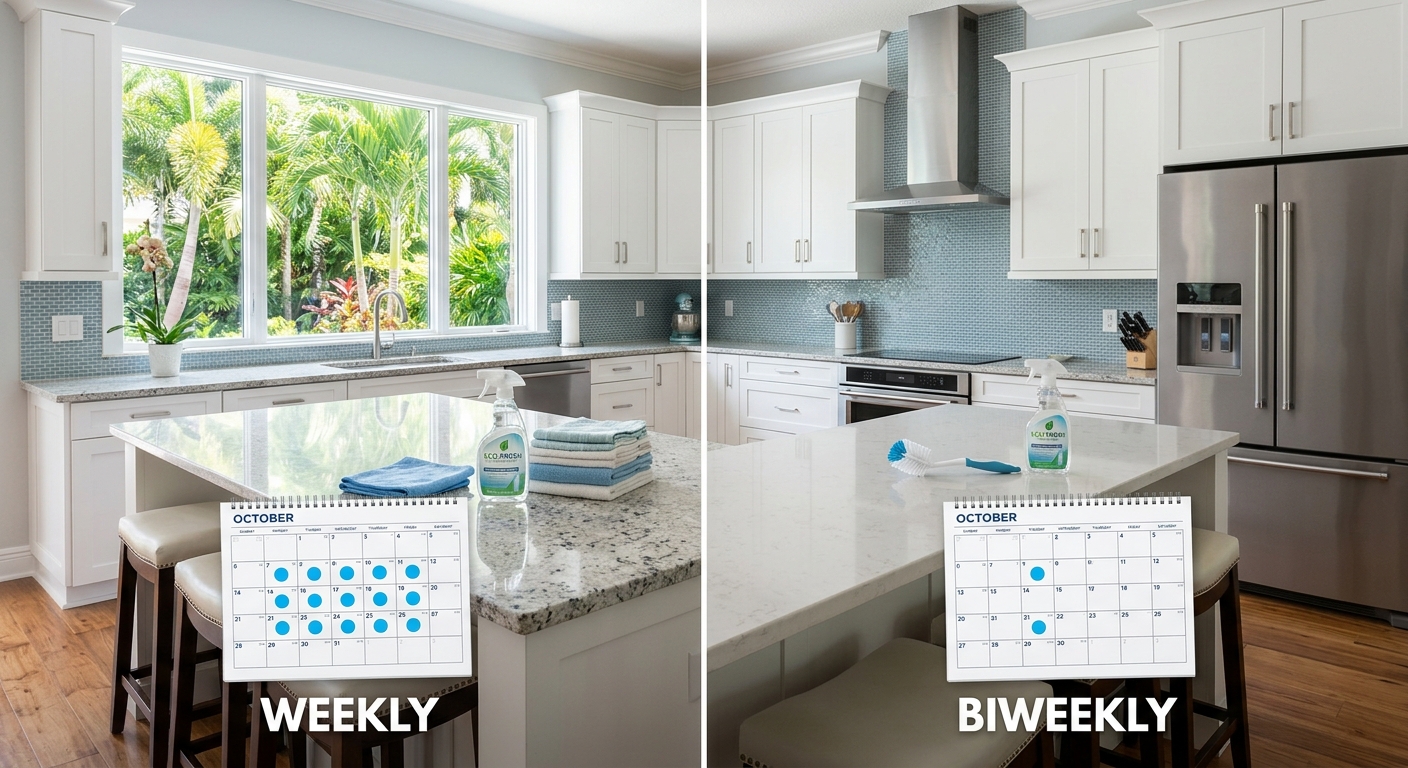
Here's a question we get on almost every phone call: "Should I book weekly or biweekly?" It sounds simple, but the answer changes your monthly bill by hundreds of dollars and determines whether your home feels consistently fresh or just periodically rescued. After years of cleaning homes across Miami-Dade, Broward, and Palm Beach counties, we've learned there's no one-size-fits-all answer — but there is a right answer for your household.
This guide breaks down the real difference between weekly vs biweekly cleaning service, using actual pricing data, hygiene research, and the patterns we've seen firsthand in hundreds of South Florida homes. By the end, you'll know exactly which schedule fits your family, your budget, and your sanity.
What You'll Learn in This Guide
- The real cost difference between weekly and biweekly cleaning (with current pricing benchmarks)
- Which household types thrive on each schedule
- What actually happens during a biweekly clean vs. a weekly one
- Hygiene and mental health reasons frequency matters more than people think
- Common mistakes homeowners make when choosing a cleaning cadence
Weekly vs Biweekly Cleaning Service: The Real Cost Breakdown
Let's start with money, because that's usually the deciding factor. Nationally, the average residential cleaning session costs around $160, though a typical 3-bedroom, 2-bathroom home in South Florida usually runs $150–$300 per visit depending on square footage and condition.
Here's where it gets interesting. Weekly service means 52 cleanings a year; biweekly means 26. On paper, weekly costs almost double. But most cleaning companies — Catalina included — offer frequency discounts, so weekly clients often pay 10–15% less per individual visit than biweekly clients do.
Even with that discount, though, the monthly totals tell the real story:
- Weekly service: typically $500–$800 per month
- Biweekly service: typically $300–$500 per month
That's a $200–$300 monthly gap, or roughly $2,400–$3,600 per year. That's a meaningful number for most households, so don't let the "per-visit discount" talking point trick you into thinking weekly is a wash cost-wise — it isn't. It's simply a lower unit price on a higher total spend.
One thing people forget: biweekly service can come with hidden costs. You'll likely spend more on your own cleaning supplies to maintain the home between visits, and if you're hosting guests or throwing a party mid-cycle, you may end up booking (and paying for) an extra one-off cleaning anyway.
Who Should Choose Weekly Cleaning
In our experience, weekly service isn't a luxury for these households — it's closer to a necessity:
- Families with young kids. Toddlers generate mess at a pace biweekly simply can't keep up with.
- Multiple-pet households. Pet hair, dander, and tracked-in dirt build up fast, especially with two or more dogs.
- Anyone managing allergies or asthma. Dust and dander accumulate quickly, and a two-week gap gives allergens time to circulate.
- Frequent entertainers. If you host regularly, weekly keeps your home guest-ready without a mad scramble.
- Anyone who spends more than two hours cleaning on their day off. That's our go-to gut check — if your "free" time is being eaten by chores, it's time to hand it off weekly.
A useful data point here: the American Cleaning Institute found that 52% of households already clean weekly on their own — meaning even without a service, most families intuitively know a seven-day cycle keeps things manageable. Professional weekly service just takes that same instinct and executes it more thoroughly.
Who Should Choose Biweekly Cleaning
Biweekly is, by a wide margin, the most popular recurring plan we book — and for good reason. It hits a sweet spot: frequent enough to prevent buildup, spaced out enough to keep the annual bill reasonable.
Biweekly tends to work best for:
- Couples or individuals without kids or pets who maintain light daily tidying themselves
- Homes with one pet and moderate foot traffic
- Households on a firmer monthly budget who still want a genuinely deep clean, not just a surface wipe
- Empty nesters or retirees whose homes simply don't get dirty as fast
Here's something a lot of homeowners don't realize: a biweekly visit is not a scaled-down weekly visit. Our teams still sanitize every high-touch surface, clean all floors, and fully refresh bathrooms and kitchens every single time. The difference is that with two weeks of buildup, we spend more time on things like baseboards, grout lines, and inside appliances — essentially, biweekly visits skew more toward deep-cleaning tasks each time, rather than light maintenance.
Pro Tip: If you're on a biweekly schedule, keep a container of disinfecting wipes under the kitchen sink and in each bathroom. Wiping down the toilet handle, faucet, and counters every few days between visits prevents the kind of grime that turns a 3-hour clean into a 4.5-hour clean. E. coli and other bacteria can survive on kitchen sinks for up to 48 hours, so a quick midweek wipe genuinely matters for a two-week cycle.
Why Frequency Actually Affects Hygiene, Not Just Appearance
It's tempting to think of cleaning frequency as purely cosmetic, but the data says otherwise. Bathrooms cleaned with bleach-based products see bacteria counts drop by 99.9%, and HEPA-filter vacuums — which we use on every job — trap 99.97% of particles down to 0.3 microns, including much of the dust and dander that triggers allergies.
The kitchen is the most frequently cleaned room in American homes, averaging 20 cleanings a month, nearly once a day, according to a 2025 Ecovacs/Censuswide survey of 1,000 U.S. adults. That same survey found bedrooms, living rooms, and dining rooms get cleaned 14–17 times a month. If your professional service only touches those spaces every other week, daily light maintenance in between isn't optional — it's what keeps the gap from becoming a problem.
There's also a wellness angle that's easy to overlook. The American Cleaning Institute reports that 87% of Americans feel a direct boost to their mental and physical well-being when their home is tidy, and separate industry surveys show 66% of people say a clean environment instantly improves their mood. If you notice your stress creeping up by day 10 of a biweekly cycle, that's real, measurable, and a legitimate reason to consider bumping up to weekly.
Product Recommendations That Bridge the Gap Between Visits
Whichever schedule you choose, the right supplies on hand make a noticeable difference in how "clean" your home feels between professional visits.
- Clorox Free & Clear Cleaning Wipes (75-count, 3-pack, ~$16.99): We recommend these over generic wipes because they're EPA Safer Choice certified and fragrance-free, which matters if you have kids, pets, or anyone sensitive to strong chemical scents in the home.
- AmazonBasics Microfiber Cleaning Cloths (24-pack, ~$6.74 with Subscribe & Save): With over 54,000 ratings averaging 4.7 stars, these are the workhorse we suggest keeping in every room. Microfiber lifts dust and bacteria mechanically instead of just pushing it around like paper towels do.
Between professional visits, a quick 10-minute pass with microfiber cloths on high-touch surfaces — doorknobs, light switches, remote controls — can reduce germ transfer significantly. Studies on high-touch disinfecting show it can cut flu transmission by up to 80% in shared spaces.
What Most Homeowners Get Wrong About Cleaning Frequency
After hundreds of jobs, we see the same misconceptions over and over:
- "Biweekly means my house will always look dirty." Not true — biweekly visits are structured to include more deep-cleaning tasks precisely because more buildup has occurred, so the end result is still a genuinely clean home, just on a different rhythm.
- "Weekly is always the healthier option." For a single person or couple without pets, weekly can be overkill. Monthly or biweekly professional cleaning paired with light daily upkeep works just fine for smaller, low-traffic households.
- "Once I pick a frequency, I'm locked in." Life changes — a new puppy, a new baby, a move, an injury. Most companies, including ours, let you adjust frequency anytime your household's needs shift.
- "Weekly always costs double." As we covered above, frequency discounts mean the per-visit price for weekly clients is often 10–15% lower, even though the monthly total is higher.
One of the trickiest situations we encounter is families who downgrade to biweekly to save money, then get frustrated when the home doesn't look "weekly-level" clean on day 13. That's not a service failure — it's a mismatch between expectations and schedule. If that sounds like you, weekly might genuinely be worth the extra cost for your peace of mind.
Frequently Asked Questions
Is biweekly cleaning enough for a house with pets?
It depends on how many pets and how much they shed. For a single pet in a moderately sized home, biweekly service usually works well. If you have multiple pets, heavy shedders, or anyone with pet allergies, weekly service tends to be the better fit to keep dander and hair from accumulating.
Can I switch between weekly and biweekly cleaning service?
Yes, and you should treat your schedule as flexible rather than fixed. Most cleaning companies, including Catalina, let you increase or decrease frequency as your household changes — after a move, a new baby, or once kids get older and the house stays tidier longer.
Does biweekly cleaning still include deep-cleaning tasks?
Absolutely. A biweekly visit isn't a lighter version of weekly — it typically includes more thorough attention to buildup areas like baseboards, grout, and appliance exteriors, alongside full sanitizing of high-touch surfaces, floors, bathrooms, and the kitchen.
How much money can I actually save going biweekly instead of weekly?
Based on current pricing benchmarks, weekly service typically runs $500–$800 a month while biweekly runs $300–$500 a month — a difference of roughly $2,400 to $3,600 per year. Just factor in that biweekly may require a bit more spending on your own supplies to maintain the home between visits.
Finding Your Right Rhythm
At the end of the day, the weekly vs biweekly cleaning service decision comes down to three questions: how fast does your home get messy, how much does that mess bother you, and what does your budget comfortably allow? Families with kids, pets, or allergy concerns typically lean weekly. Couples, singles, and lower-traffic homes often do great on biweekly, especially when paired with a little daily upkeep.
If you're still not sure which schedule fits, that's a completely normal place to be — most of our clients start with one frequency and adjust after their first month or two once they see how their home actually holds up. If you'd rather leave the guesswork (and the scrubbing) to the pros, our team offers both recurring cleaning plans and one-time deep cleaning services across Miami-Dade, Broward, and Palm Beach counties, including recurring cleaning in Fort Lauderdale and deep cleaning in Boca Raton. You can also check out our full house cleaning cost guide to compare pricing in more detail before you decide.