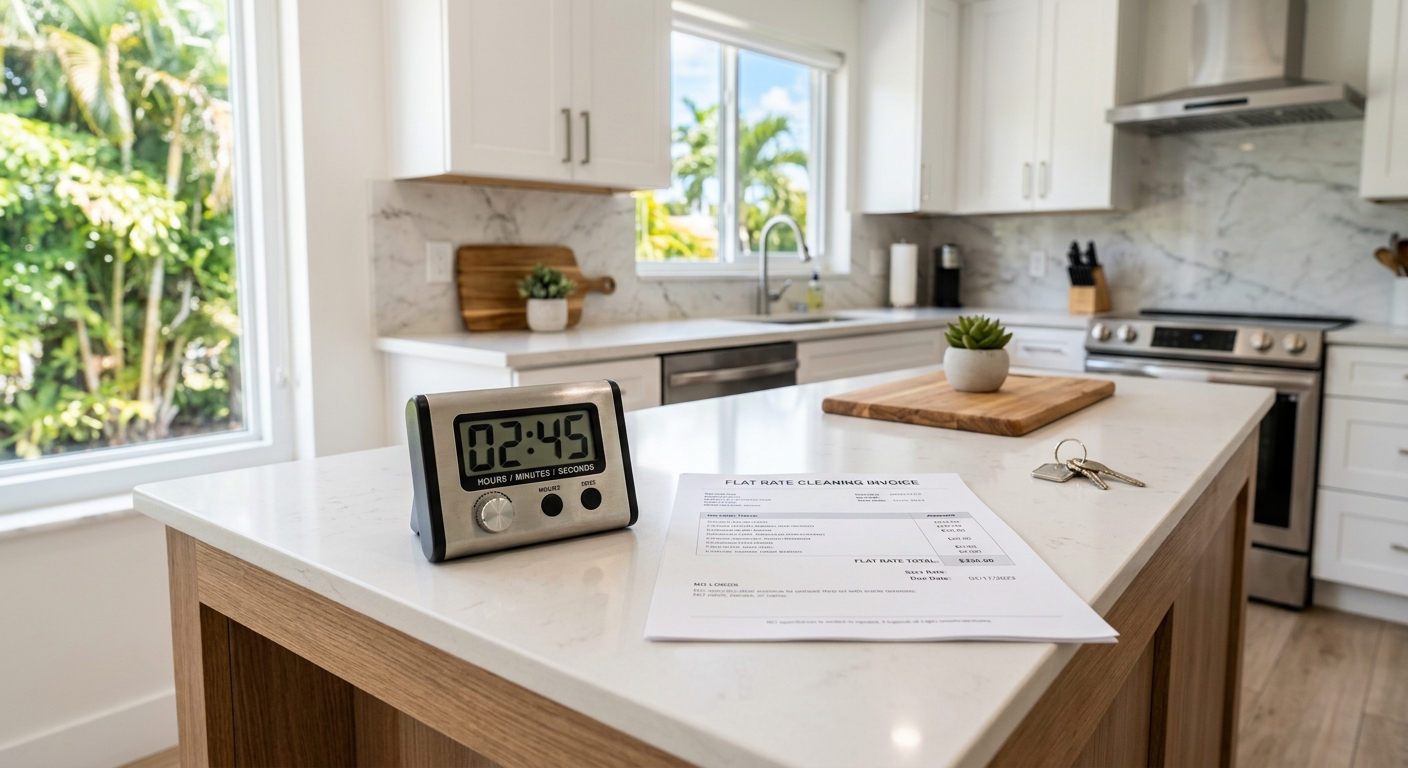
You call three cleaning companies. One quotes $45 an hour. Another quotes $180 flat. The third asks a bunch of questions about your home before giving you a number at all. Which one is actually the better deal? The honest answer is: it depends on your home, your history with the cleaner, and how many hours that "cheap" hourly rate quietly turns into.
After booking and running hundreds of cleanings across South Florida, we've watched homeowners get surprised in both directions — the flat-rate client who felt like they overpaid for a quick job, and the hourly client who opened their wallet expecting $135 and got billed $220. This guide breaks down the real math behind hourly vs flat rate house cleaning, using current 2026 industry pricing data, so you can pick the model that actually protects your budget.
Here's what we'll cover:
- What hourly cleaning really costs once you factor in team size
- What flat-rate pricing actually includes (and where it can go wrong)
- The "first clean premium" almost nobody explains upfront
- Which model wins for recurring service vs one-time cleans
- Common mistakes homeowners make when comparing quotes
What Hourly House Cleaning Actually Costs You
Hourly pricing sounds simple: you pay for the time worked, nothing more. In practice, the number on the quote is rarely the number on your invoice.
In 2026, most house cleaning services charge $30 to $75 per cleaner, per hour, depending on whether you're hiring a solo independent cleaner or an insured company. Solo cleaners tend to cluster around $30–$45 an hour. Established, insured companies — the ones carrying liability coverage and workers' comp — typically run $45–$75 per cleaner per hour, because that rate has to cover more than just the person mopping your floor.
Here's the detail that trips people up: most standard cleanings send two people, not one. If a company quotes "$50 an hour," that's usually $50 per cleaner. Send a two-person team for three hours, and you're not looking at $150 — you're looking at $300. We've had new clients call confused about their invoice for exactly this reason, and it's almost always a per-cleaner rate misunderstanding, not an error.
- Solo independent cleaner: $30–$45/hour
- Insured cleaning company, per cleaner: $45–$75/hour
- Two-person team, combined: roughly $50–$100+ per hour for the job
Regional market also matters more than most people expect. Coastal metros run 20–40% above the national average. Miami sits close to $45 an hour on the national scale — comparable to New York City — while cities like Denver, Chicago, and Los Angeles average closer to $39. Washington, D.C., Boston, and the San Francisco Bay Area sit at the very top, north of $50–$58 an hour. If you're comparing a Miami quote to a rate you saw online from a Midwest cleaning blog, that's part of why the numbers don't match.
What Flat-Rate House Cleaning Actually Costs You
Flat-rate pricing works differently. Instead of billing time, the company estimates the job based on square footage, bedroom and bathroom count, current condition, and how long similar homes typically take. You get one number before anyone walks in the door.
National data for 2026 puts a standard visit for a typical 2,000-square-foot, three-bedroom home at $120 to $280 per visit, with most jobs landing between $174 and $256 and an average around $176–$180. On a per-square-foot basis, standard cleaning runs roughly $0.10 to $0.20, while deep cleaning runs $0.15 to $0.30 per square foot and typically costs 50–100% more than a standard visit — Angi's 2026 data shows deep cleans averaging $260 against $176 for a standard clean.
The appeal of flat-rate pricing is predictability. You know the number before the cleaner arrives, and it doesn't change if the team finishes in two hours instead of three. That last part is the key mechanic homeowners rarely think about: flat rate rewards efficiency. If we quote a three-bedroom home at $180 and our team gets it done in 2.5 hours instead of 3, the effective hourly rate goes up for us — and you still pay $180, not less, but also not more if something takes longer than expected.
That's also the risk. If a company underestimates how dirty a home is, they either eat the loss or (with a poorly run business) rush the job to hit their internal time target. This is why the reputation and process of the company matters more with flat-rate pricing than the number itself.
The First Clean Premium Nobody Explains Upfront
This is the single biggest reason people feel misled by cleaning quotes, and it applies to both pricing models.
The first visit to any home routinely takes twice as long as visit five. A recurring client's kitchen that gets wiped down every two weeks is a different job than a kitchen that hasn't seen a deep wipe-down in eight months. Baseboards, ceiling fans, inside the microwave, built-up soap scum in the shower — all of it adds real time on visit one that simply isn't there once a maintenance rhythm is established.
Because of this, most professional operators — including us — quote the first clean separately, usually at 1.5–2x the recurring rate. If a home's recurring flat rate will eventually settle at $150, the honest first-visit quote might be $220–$280 to account for the extra baseline work. Some companies price the first clean hourly specifically because they don't yet know the home, then move you to a flat rate once they've seen the actual condition and timing.
Pro Tip: If a company gives you a suspiciously low flat rate for a first-time deep clean without ever asking about pets, last cleaning date, or square footage, that's a red flag — not a bargain. They're either guessing, or they're planning to rush the job to protect their own margin.
Hourly vs Flat Rate House Cleaning: Which Wins for Recurring Service?
For a one-time clean, hourly makes sense. Neither you nor the cleaner has a shared history with the home, so time-based billing protects both sides from a bad guess.
For recurring service, flat rate wins in almost every scenario we've seen. Once a team has cleaned your home two or three times, they know exactly how long your layout takes, where the trouble spots are, and how your household lives day to day. At that point, a fixed weekly, biweekly, or monthly rate is more predictable for your budget and rewards the cleaning team for staying efficient rather than watching the clock.
Recurring frequency also unlocks real discounts industry-wide:
- Weekly service: commonly 20–25% cheaper than one-time pricing
- Biweekly service (most popular choice): typically 10–15% off
- Monthly service: around 5% off
This is part of why we structure most Miami-Dade, Broward, and Palm Beach clients into recurring cleaning plans rather than one-off hourly bookings — the savings compound, and the team gets faster and more familiar with your home over time, which is good for everyone's bottom line.
When Hourly Actually Makes Sense
Hourly billing isn't a bad model — it's just the right tool for specific situations:
- Post-renovation cleanups, where dust and debris levels are unpredictable
- Hoarding or extreme clutter situations, where nobody can estimate time accurately
- Small apartment or studio cleans where the job is short and the risk of overpaying is low
- One-time cleans with an unknown home history, before a flat rate can be quoted responsibly
For move-out and move-in cleaning specifically, pricing tends to be quoted flat but at a premium because these jobs almost always involve buildup that a standard visit never sees — think inside every cabinet, oven interior, baseboards, and window tracks. Expect $250–$600 for a full move-out clean, or $0.22–$0.33 per square foot, depending on the home's size and condition. If you're relocating within South Florida, our moving cleaning service is quoted this way for exactly that reason.
What Most Homeowners Get Wrong About Hourly vs Flat Rate Pricing
After fielding hundreds of pricing calls, we see the same misunderstandings come up again and again.
- Assuming the hourly rate is per job, not per cleaner. A two-person team at $45/hour each is $90/hour combined, not $45.
- Comparing a flat rate for recurring service against an hourly quote for a first-time deep clean. These aren't the same job — the first one already includes months of buildup the recurring rate never has to cover.
- Thinking a lower hourly number means a lower total price. Solo cleaners at $35/hour sound cheaper than a company at $60/hour, but if the solo cleaner takes 5 hours and the trained two-person team finishes in 2.5 hours combined, the totals can land close to each other — with very different quality control and insurance protection.
- Not asking what's included. Some flat rates cover inside the oven and fridge; others treat those as add-ons. Always ask for the scope in writing.
We've also found that homeowners rarely factor in labor economics when they're surprised by rising prices. The Bureau of Labor Statistics puts the median wage for building-and-grounds cleaning workers at around $17 an hour nationally. In 2026, 22 states and 66 cities raised their minimum wage, and every time the wage floor rises in a market, cleaning prices — hourly and flat — follow it upward within a few months. If your regular cleaning service raised rates this year, this is very likely why.
Two Tools That Actually Affect How Long — and How Much — Your Clean Costs
Since flat-rate pricing rewards speed without sacrificing quality, the tools a team uses matter more than people assume. Two we specifically recommend and use:
- Bar Keepers Friend instead of generic abrasive powders for stainless steel sinks, glass cooktops, and hard water stains on shower glass. It cuts mineral buildup in one pass instead of three rounds of scrubbing, which is the difference between a bathroom taking 20 minutes or 40.
- A backpack HEPA vacuum (professional-grade, like a ProTeam) instead of an upright. It's lighter to carry between rooms, has stronger suction on stairs and under furniture, and cuts vacuuming time across a full home by roughly a third compared to standard consumer models — which is exactly the kind of efficiency gain that keeps flat-rate pricing fair for everyone.
If you want a deeper breakdown of what's included in a heavier clean versus a standard maintenance visit, our deep cleaning service page walks through the scope difference, and our Miami house cleaning cost guide breaks down local pricing by home size.
Frequently Asked Questions
Is hourly or flat rate cheaper for house cleaning?
For recurring service in a home the cleaning team already knows, flat rate is almost always the better value because it rewards efficiency and gives you a predictable number. For a one-time clean or an unpredictable situation like post-renovation dust, hourly protects you from paying for guesswork that turns out wrong.
Why did my first cleaning cost more than the recurring rate I was quoted?
This is standard industry practice, not a bait-and-switch. The first visit to a new home typically takes about twice as long as visit five because it includes baseline deep-cleaning work — baseboards, built-up grime, appliance interiors — that a maintenance visit doesn't need to repeat. Most companies quote the first clean at 1.5–2x the ongoing recurring rate for exactly this reason.
Why do two cleaners cost more than one, even at the same hourly rate?
Hourly rates in most cleaning companies are quoted per cleaner. A two-person team at $45 an hour each bills at a combined $90 an hour, not $45, even though the job finishes faster. Always ask whether a quoted hourly rate is per person or per job before comparing companies.
Does recurring cleaning frequency actually lower my price?
Yes. Industry-wide, weekly service commonly runs 20–25% cheaper than one-time pricing, biweekly (the most popular frequency) runs about 10–15% cheaper, and monthly service saves around 5%. The more consistent the schedule, the more predictable — and usually cheaper — the per-visit rate becomes.
The Bottom Line
There's no universal winner in the hourly vs flat rate house cleaning debate — it genuinely depends on whether it's a one-time job or an ongoing relationship. Hourly protects you (and the cleaner) when nobody knows what they're walking into. Flat rate rewards a team that already knows your home and wants you to trust the number on the invoice before anyone touches a mop.
If you'd rather skip the math and leave the pricing decisions to people who quote hundreds of homes a month, our team serves recurring and one-time cleanings across Miami, Fort Lauderdale, and Boca Raton. We're happy to walk you through exactly what your home would cost under either model — no pressure, just an honest number.