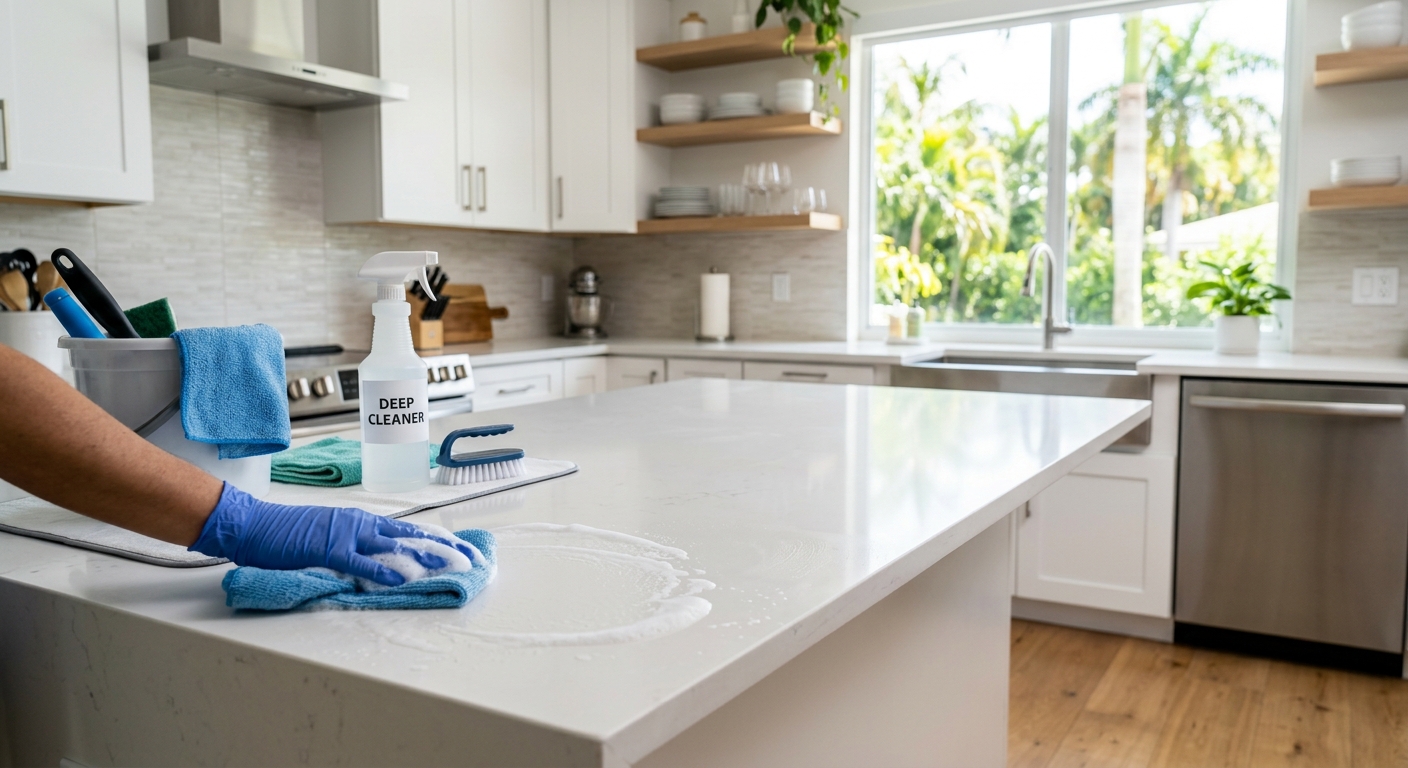
If you've ever booked your first professional deep clean and then spent the whole day wondering what was actually happening behind that closed bathroom door, you're not alone. Most homeowners have a vague idea that "deep cleaning" means something more than the usual wipe-down, but they don't actually know what to expect from a first deep cleaning service in terms of time, tasks, or results. That uncertainty is completely normal, and after handling hundreds of these appointments across South Florida, we've noticed the same questions come up again and again.
This guide walks through exactly what happens during a first deep clean, hour by hour, so you know what's normal, what's optional, and what should raise a flag. We'll also cover the biggest misconceptions homeowners have, the products we actually reach for, and how often you really need to schedule one of these once the first pass is done.
What to Expect From Your First Deep Cleaning Service, Hour by Hour
Deep clean timelines vary a lot depending on square footage, clutter level, and how long it's been since the last real scrub-down. In our experience, a typical three-bedroom, two-bathroom home takes about 6 to 8 hours for a first-time deep clean, while a one-bedroom apartment might wrap up in 1.5 to 2.5 hours. Larger or heavily soiled homes, especially those with pets or years of buildup, can stretch past 10 hours or require a two-person crew to finish in a single visit.
Hour 0: Walkthrough and Supply Staging
Before anyone touches a sponge, a good cleaner does a quick walkthrough of the home. This is where we flag anything unusual, like water stains that suggest a slow leak, or a stovetop that needs extra degreasing time. We also stage a cleaning caddy stocked with everything needed room to room, because constantly walking back to a supply bag wastes real time on a job that's already billed hourly or by flat rate.
If there's visible clutter, this is also when a brief tidy-up happens. Clearing countertops and floors so surfaces are actually reachable can take 10 to 20 minutes depending on how much is out. This isn't organizing your closets. It's just making the space cleanable.
Hours 1-2: The Kitchen
The kitchen is almost always the most time-intensive room in a deep clean, and it's usually where the biggest difference between "regular clean" and "deep clean" becomes obvious. Regular cleaning wipes counters and sweeps floors. Deep cleaning goes into the places that get ignored for months at a time.
- Interior of the microwave, including the vent filter above it
- Inside the oven, if requested (this often requires a degreaser to sit and work for 15-20 minutes before scrubbing)
- Behind and underneath small appliances that haven't moved in a while
- Cabinet exteriors, and interiors if requested, including grease buildup near the stove
- Refrigerator exterior and door seals, sometimes the interior shelving too
- Backsplash grout lines, which trap grease in a way flat tile never does
Pro Tip: If your oven has heavy baked-on carbon, ask your cleaner to apply the degreaser first and finish other kitchen tasks while it sits. Trying to scrub cold, dry carbon buildup immediately just wastes elbow grease and time that dwell time would have done for free.
Hours 2-4: Bathrooms
Bathrooms are smaller than kitchens but often take just as long because of grout, hard water scale, and fixtures. This is where cleaning and disinfecting are two genuinely different steps, not one spray-and-wipe motion.
According to CDC guidance, cleaning must happen before disinfecting, because organic soil and soap scum physically block disinfectants from reaching the surface underneath. Skipping straight to a disinfecting wipe on a grimy shower wall looks tidy but doesn't actually kill much of anything. We always clean and rinse first, then apply a disinfectant and let it sit for its full contact time, which ranges from about 30 seconds for some alcohol-based sprays up to 10 minutes for hospital-grade quaternary products.
For hard water buildup on faucets and shower doors, we lean on Bar Keepers Friend over generic abrasive cleaners because its oxalic acid formula dissolves mineral scale without scratching chrome or fiberglass the way harsher powders can. For general bathroom disinfecting, Lysol Power is one we keep stocked because it's labeled to kill 99.9% of bacteria and viruses when used according to its dwell time, not just wiped and rinsed immediately.
Hours 4-6: Bedrooms and Living Areas
These rooms move faster than the kitchen and bathrooms because there's less grease and moisture damage to deal with, but a real deep clean still goes beyond a quick vacuum. Expect baseboards wiped down, ceiling fans and vent covers dusted, window sills detailed, light switches and door frames wiped, and furniture moved to vacuum underneath rather than around it.
Pro Tip: Ask your cleaner to vacuum mattress seams and under bed frames during a first deep clean. Dust mite debris and pet dander collect there constantly, and it's one of the most commonly skipped spots in a standard cleaning routine.
Hours 6-8: Floors, Final Touches, and Walkthrough
Floors get done last so nobody re-tracks dirt through a freshly cleaned room. This usually means a full vacuum pass followed by mopping with attention to corners and edges where dust and hair collect. Trash cans throughout the house get emptied and relined with fresh bags as one of the final steps, which sounds minor but is genuinely one of the most satisfying parts of a deep clean walkthrough.
A final walkthrough with the homeowner, when possible, is where you get to flag anything missed before the cleaner packs up. This is normal and expected, not a sign something went wrong.
Deep Cleaning vs. Regular Cleaning vs. Disinfecting: Know the Difference
One of the most common points of confusion we run into is homeowners treating "cleaning," "sanitizing," and "disinfecting" as interchangeable words. They're not, and understanding the difference changes what you should actually expect from a first deep clean appointment.
- Cleaning physically removes dirt, dust, and debris using soap or detergent and water. It doesn't kill germs, but tests referenced by the EPA have found that cleaning with just microfiber and water can remove up to 98% of bacteria and 93% of viruses from a surface.
- Sanitizing reduces bacteria levels to what's considered a safe threshold, but it doesn't claim to eliminate everything.
- Disinfecting kills the specific pathogens listed on a product's label, but only when applied to an already-cleaned surface and left wet for the product's required contact time.
This is exactly why a thorough deep clean takes longer than people expect. Skipping the cleaning step and going straight to disinfectant wipes might look efficient, but it leaves organic soil sitting on the surface, actively neutralizing the disinfectant's active ingredients.
What Most Homeowners Get Wrong About Their First Deep Clean
After cleaning hundreds of homes across Miami-Dade, Broward, and Palm Beach counties, a few misconceptions come up constantly.
Mistake 1: Assuming Deep Cleaning Is a Monthly Necessity
Most homes only need a true deep clean once or twice a year, not monthly. High-activity households with kids or pets do better on a quarterly schedule, average-maintenance homes are fine biannually, and post-renovation or post-move cleanings are their own separate category entirely. Regular upkeep in between, through recurring cleaning, is what actually keeps a home from needing a deep clean more often.
Mistake 2: Expecting the Same Timeline as a Standard Clean
A standard clean and a first deep clean are not the same job wearing a different name. One Trustpilot review we came across summed up a frustration we've heard before: a customer expected a 5-6 hour deep clean and felt they got "more like a 4.5 hour regular clean." That gap usually comes from unclear expectations going in, not corner-cutting. Confirming exactly which tasks are included, like inside-oven cleaning or baseboard washing, before the appointment prevents that disappointment.
Mistake 3: Thinking More Product Means More Clean
Dumping extra disinfectant on a dirty surface doesn't compensate for skipping the cleaning step first. Contact time and a clean surface matter more than how much product gets sprayed.
Mistake 4: Trying to Do It All in One Marathon Session
If you're tackling this yourself rather than booking a deep cleaning service, breaking the job into two days is a completely valid approach. Trying to power through an 8-hour job solo in one sitting is how people burn out halfway through and never touch the baseboards.
Tools and Products Worth Having on Hand
You don't need a professional-grade arsenal to get real results, but a few specific products consistently outperform generic versions in our experience.
- Bar Keepers Friend for hard water stains, soap scum, and stainless steel sinks, because its mild acid formula cuts mineral buildup without scratching surfaces the way harsher powders can.
- Microfiber cloths (a 12-pack runs around $12 during sale periods) are worth buying in bulk since a fresh cloth per surface prevents cross-contamination between the toilet and the kitchen counter.
- Lysol Power for bathroom disinfecting after the surface has already been cleaned and rinsed.
- A basic electric spin scrubber for grout lines and shower tracks, which cuts scrubbing time dramatically compared to a manual brush.
If you're comparing the cost of doing this yourself in supplies versus hiring it out, our breakdown of house cleaning costs in Miami is a useful place to see where the numbers land.
Frequently Asked Questions
How long does a first deep cleaning service usually take?
Most single-family homes take between 6 and 10 hours for a thorough first deep clean, while apartments typically take 1.5 to 2.5 hours. Homes with pets, heavy buildup, or multiple bathrooms often run on the longer end of that range.
What's included in a deep clean that isn't part of a regular cleaning?
Deep cleans typically add inside-appliance cleaning, cabinet interiors, baseboard washing, grout scrubbing, window sill detailing, and behind-furniture vacuuming, none of which are standard in a routine maintenance visit.
Do I need to declutter before the cleaner arrives?
A light tidy-up helps, since cleaners need clear access to counters and floors to actually clean them, not just move things around. You don't need to deep-organize closets or drawers unless that's specifically part of what you booked.
How often should I schedule a deep clean after the first one?
Most homes do well with a deep clean every 3 to 6 months, with quarterly service recommended for households with pets or young kids. In between, standard cleaning visits keep things from sliding back to square one.
The Bottom Line on What to Expect From Your First Deep Cleaning Service
Now that you know what to expect from a first deep cleaning service, hour by hour, the process should feel a lot less like a mystery and a lot more like a plan. The key things to remember: it takes longer than a regular clean, cleaning and disinfecting are genuinely different steps, and you only need to repeat the full deep clean a couple of times a year if you keep up with maintenance in between.
If you'd rather leave the ovens, grout lines, and baseboards to someone who does this every day, our team offers deep cleaning service in Fort Lauderdale and throughout Miami-Dade, Broward, and Palm Beach counties. We're happy to walk through exactly what's included before we ever step through the door.